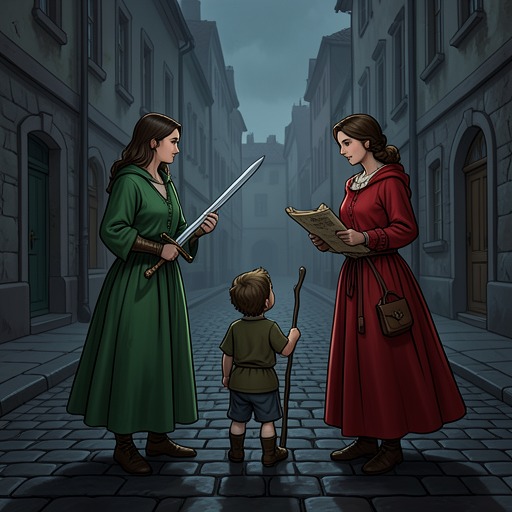
Alicent Hightower
Fire & BloodAlicent Hightower’s rise from the young companion of a dying king to queen and political organizer helped turn a succession dispute into a dynastic war. As wife of Viserys Targaryen and mother of his sons, she stood at the center of a court divided between the rights of Rhaenyra Targaryen, the king’s declared heir, and the ambitions of Alicent’s children. Her later life reversed that ascent: after the deaths of her children and the collapse of her party, she was confined in Maegor’s Holdfast, where she died in isolation.
Early Life and Marriage
Alicent was the daughter of Otto Hightower, who served as Hand of the King under Jaehaerys Targaryen. When the Old King’s strength failed, the fifteen-year-old Alicent became his constant companion, bringing his meals, reading to him, and helping him bathe and dress. Jaehaerys sometimes mistook her for one of his daughters; near the end of his life, he believed she was Saera, returned to him. Her place beside the king connected her closely to the royal household before she became a queen.
After Viserys became king, Otto helped shape the question of who would succeed him. He opposed the prospect of Daemon Targaryen inheriting the Iron Throne, and at that point favored Rhaenyra as the alternative. Viserys, however, chose his own bride: Alicent, then eighteen, whose companionship to the dying Jaehaerys had preceded her marriage. Her family’s ancient and noble standing offered no formal obstacle, although rumors claimed that Otto had brought her to court intending to secure the match, and some questioned whether she had been intimate with Viserys before the death of Queen Aemma. The book notes that these accusations were never proved.
The marriage placed Alicent within a succession already shaped by earlier decisions. The Great Council had chosen Viserys over Rhaenys Targaryen by a reported margin of more than twenty to one, although the recorded tally was never disclosed. Viserys later continued to recognize Rhaenyra as his heir even after Alicent bore him sons. The resulting tension was not simply between two women: it concerned whether the king’s stated choice or the claims of his male descendants would determine the next reign.
The Queen’s Party and the Succession Dispute
Alicent bore Viserys three sons and a daughter: Aegon in 107 AC, Helaena two years later, and Aemond in 110 AC. Rhaenyra, meanwhile, remained at court beside her father and began attending small council meetings. She was the acknowledged Princess of Dragonstone, and many lords had sworn to defend her rights. Yet Alicent and Rhaenyra both sought primacy at court, and the birth of male heirs sharpened the political stakes without changing the king’s declared succession.
Even after Otto returned to Oldtown, a group of powerful lords friendly to Alicent and supportive of her sons remained at court. Opposed to them was the party aligned with Rhaenyra. Viserys tried to preserve peace between his wife and daughter through gifts, honors, and the maintenance of a balance between them. The calm was real but fragile: observers noted that the dragons belonging to the two parties snapped and spat flame when they passed close to one another.
The factions acquired their familiar colors at a great tourney in King’s Landing in 111 AC, held on the fifth anniversary of Viserys and Alicent’s marriage. Alicent wore green; Rhaenyra appeared in Targaryen red and black. The names Greens and Blacks thereafter distinguished the queen’s party from the princess’s. The competition carried into the tourney itself: Criston Cole, wearing Rhaenyra’s favor, defeated all of Alicent’s champions, including her cousins and her youngest brother, Gwayne Hightower. Public ceremony thus gave the court’s divisions a visible vocabulary, while the contests within it offered an early display of allegiance.
Alicent also pressed her interests in matters of royal appointment. When Viserys’s hand was injured on the Iron Throne, Rhaenyra argued that Maester Gerardys should replace Grand Maester Mellos, crediting Gerardys with saving the king’s life. Alicent disputed the treatment, claiming that Rhaenyra and her maester had intervened unnecessarily, and backed Maester Alfador, then serving at the Hightower. Viserys refused to choose either candidate, noting that the Citadel, not the Crown, selected the Grand Maester. The Conclave eventually appointed Archmaester Orwyle. The dispute showed how medical care, court service, and institutional authority could become part of the same political contest.
The Green Council and Aegon’s Accession
As Viserys neared death, Alicent and her allies were prepared to act. Septon Eustace later reported that a servant brought news of the king’s death directly to Alicent rather than raising a general alarm. Eustace argued that the death had long been anticipated and that the Greens had instructed the king’s guards and servants in advance about what to do. In the council that followed, Alicent insisted that the Iron Throne belonged by right to the king’s eldest trueborn son.
The Greens moved quickly while Rhaenyra was confined on Dragonstone and about to give birth. They planned Aegon’s coronation, considered allies and enemies in case Rhaenyra rejected his accession, and benefited from the time she remained unaware of Viserys’s death. Alicent’s party treated delay as a political advantage: the longer the rival claimant lacked the news, the less time she had to respond.
Alicent’s son’s accession also involved resources and alliances. Tyland Lannister replaced the late Lord Beesbury as master of coin and divided the royal treasury among four destinations: the Iron Bank of Braavos, Casterly Rock, Oldtown, and a reserve intended for bribes, gifts, and sellswords. Otto sought naval support from Dalton Greyjoy by offering him the mastership of ships and a seat on the council in exchange for allegiance. Alicent’s claim for her son was thus pursued alongside the practical work of securing money, offices, and military support.
When Rhaenyra later entered King’s Landing, Alicent emerged from Maegor’s Holdfast with Otto, Tyland, and Jasper Wylde. She proposed a great council to decide the succession, invoking the precedent of Jaehaerys’s reign. Rhaenyra rejected the proposal and demanded that Alicent yield or face the consequences. The encounter exposed the limits of negotiation after the rival claimants had each built power around a different account of who should rule.
Defeat, Survival, and Confinement
As the war turned against the Greens, Alicent witnessed reversals that narrowed her family’s prospects. News of betrayal at Tumbleton reached King’s Landing while she and Rhaenyra were both present in the city. Alicent reportedly laughed at the news, while Rhaenyra ordered the gates closed to prevent defections and rebel entry. The same report that prompted one woman’s grim satisfaction drove the other to seal the city against the advancing danger.
Helaena’s death further changed how the people of King’s Landing regarded Alicent’s family. After Helaena died by suicide in Maegor’s Holdfast, rumors that she had been murdered spread rapidly. The speed with which the accusation was believed was presented as evidence of the city’s hostility toward Rhaenyra and its former affection for Helaena. Alicent mourned her daughter and cursed her rival. The loss joined the earlier deaths of her sons Jaehaerys and Maelor in shaping the city’s response to the conflict and the queen’s grief.
Alicent survived the fall of the Greens, but survival did not restore her place at court. When King’s Landing faced the approaching forces of Borros Baratheon, she took part in negotiations alongside Larys Strong and Grand Maester Orwyle. The agreement made with Borros included the restoration of Aegon II, pardons for Perkin the Flea and his followers, and a proposed marriage between Aegon and Cassandra Baratheon. Later, during negotiations involving Corlys Velaryon, Alicent initially reacted angrily to his terms, which included naming Rhaenyra’s son Aegon as heir to his own namesake. Larys reminded her of what had been discussed in Borros’s tent, and she consented to Corlys’s proposals. These episodes show her continuing to participate in political bargaining even as the faction she had helped build was breaking apart.
Alicent was eventually arrested by men wearing the seahorse of House Velaryon. They killed the guards but did not harm her or her ladies, and she was taken to the dungeons. By then, her last surviving son was already dead. At the wedding of the young king and Jaehaera, Alicent was conspicuously absent, though she was the bride’s grandmother. The absence marked her exclusion from the public ceremonies that were meant to stabilize the postwar dynasty.
The regents did not wish to execute Alicent, from compassion or from fear that her death might renew the fighting, but they considered her too dangerous to return to ordinary court life. She cursed the king and might seize a guard’s dagger; during a meal with Jaehaera, she urged the child to kill her husband in his sleep, frightening the young queen. Tyland therefore confined Alicent to her apartments in Maegor’s Holdfast. The confinement was described as gentle, but it remained imprisonment, and it separated her from the political world in which she had once been so influential.
Final Years and Legacy
Alicent died after outliving all four of her children. In the last year of her life, she had no company beyond her septa, the serving girls who brought her food, and the guards outside her door. Books, needles, and thread were provided, but the guards said she spent more time weeping than reading or sewing. She tore her clothing into pieces and eventually began talking to herself. The color green, once the public emblem associated with her political party, became an object of deep aversion.
In her final days Alicent seemed more lucid. She spoke of wanting to see her sons and Helaena again, and also remembered Jaehaerys, whom she had read to as a girl. She did not speak of Viserys in these last recollections. After confessing her sins to her septa, she died on a rainy night at the hour of the wolf, the same night as Lord Westerling.
Her life moves from intimate service to royal power and then to enforced isolation. The girl who read to a king became the queen whose household contested the succession; the mother who sought the crown for her son ended with every child dead and her own access to the court revoked. The repeated contrast between public signs and private costs is central to her story: the green gown that gave a faction its name outlasted the faction as a source of distress, while the political victory she pursued could not protect her family from the war it helped unleash.